





The Code of Kharkiv: why corporation-cities survive any empire
Blogs | 23 August, 2026 at 17:18 | 1,596 | Author: Olena Zelenina
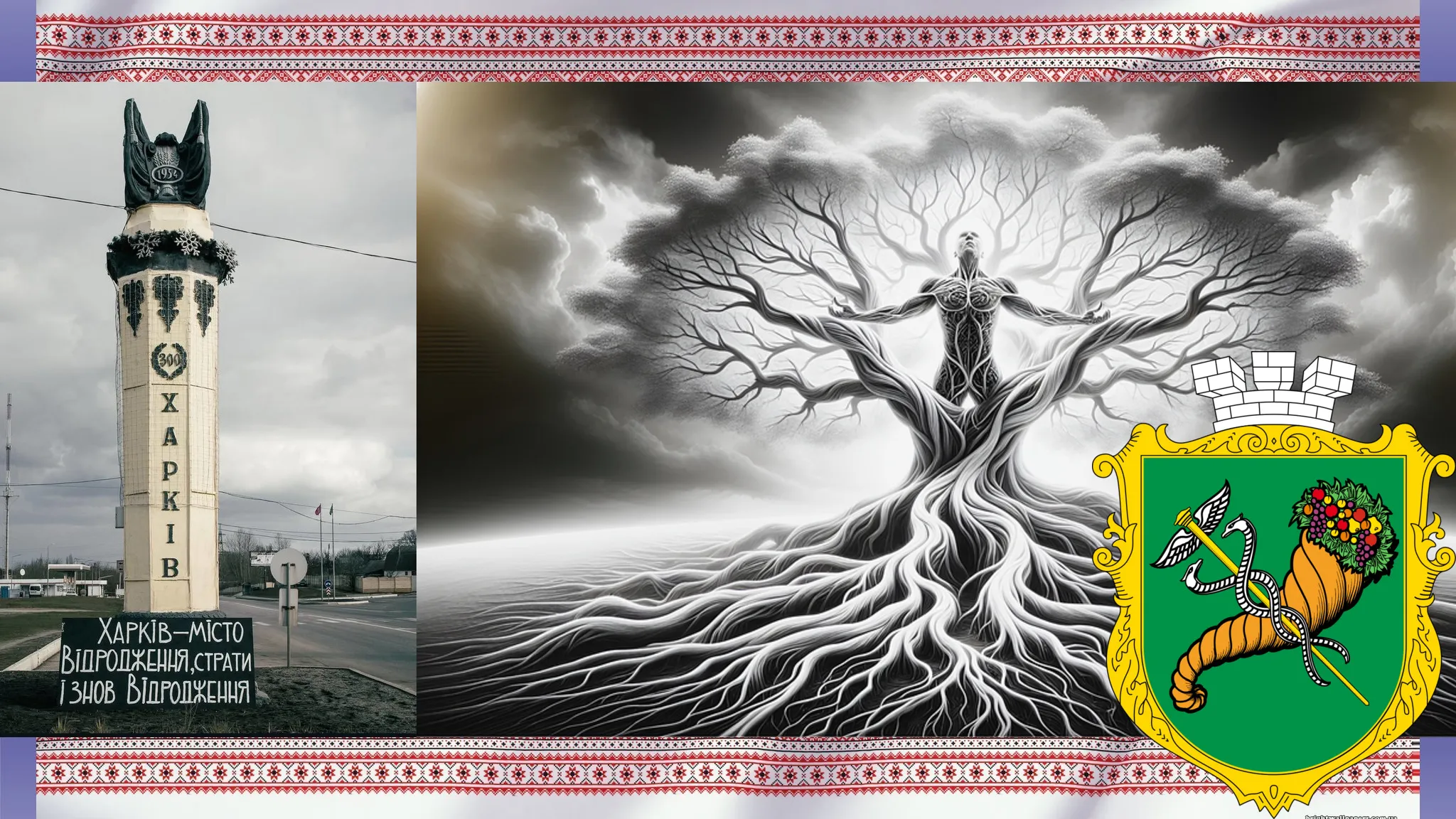
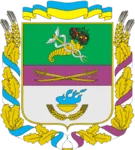
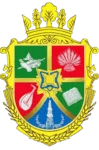
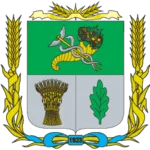
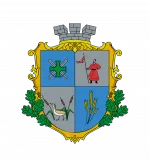
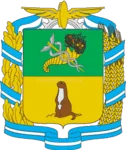
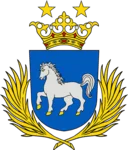
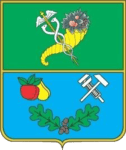
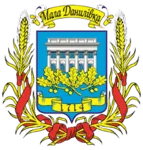
Collage by Olena Zelenina.
Imagine: the dimly lit hall of the Wrocław Museum, 16th-century altar painting — a grandiose, austere epitaph from 1581 titled "The Brazen Serpent." And suddenly my eyes see something I have never encountered before in sacred art!
At the bottom of the sacred plot, at the feet of the crucified Christ and Moses' Brazen Serpent, alongside biblical characters... entirely real, earthly, portrait-like people are painted!
In whole families, with wives and children, they stand in their heavy 16th-century velvet robes, with coats of arms at their feet, praying and demanding their own, personal place beside the Creator!
This was true astonishment. Why are they here? Who gave them this right?
Shock before the epitaph,
or Where discoveries begin
And then I began reading into the epigraphic inscription and art historians' research — and a whole detective plot opened before me:
"In the year 1581, on the 14th day of April, the noble and honorable Niklas Uthmann the Elder blissfully departed in the Lord. Before this, in the year 1547... passed away Lady Anna, born Rübish, his first wife, and then, in the year 1564... Lady Anna, born Kromeyer, his second lawful beloved wife..."
Why, this isn't a prayer! The inscription deciphers the figures at Christ's feet: on the left — Niklas Uthmann himself, in the center — his first deceased wife Anna Rübish, on the right — his second wife Anna Kromeyer!
For a Catholic worldview, this would be nonsense. But for Protestant Wrocław of the 1580s, it was a majestic manifesto of the Lutheran revolution: a person is saved not by Vatican indulgences, but by their own faith!
Everyone can turn to God directly, without priest-intermediaries. Salvation is granted through personal faith in God, not through rituals or good deeds. Scripture Alone: the Bible is the sole source of truth, without papal commandments.
And here I guess that behind this religious impulse lay... a reinforced-concrete political and financial calculation!
Historical research allows us to quickly clarify: Anna Rübish was the daughter of the royal customshouse officer and the main "oligarch" of Wrocław. Anna Kromeyer was the daughter of the city secretary, a close friend of the reformer Melanchthon (1497–1560) himself — a prominent German humanist, theologian, and educator, the closest associate of Martin Luther.
I just wanted to exclaim: look at these people!
And their daughters were given in marriage to the ringleaders of the court and administration. Before me on the sacred canvas was painted a visual map of a dynastic corporation that controlled an entire region!
Arsenic kilns and the purchase of freedom:
how to bend an empire
It takes your breath away how this city syndicate worked! The Uthmanns came from the Sudetes, owned gold mines and arsenic kilns in Złoty Stok, smelted copper, and lent money to monarchs.
And imagine: above them stands the then-Emperor Habsburg — a fanatical Catholic who dreams of burning Protestantism out with fire. And Wrocław... laughs in his face and remains Lutheran!
How?! Through purchasing a legal offshore!
Every time the emperor needed money for the war with the Turks, the Wrocław patricians brought out heavy bags of gold. They provided the Habsburgs with multi-million loans, and in return demanded: "Don't stick your nose into our schools and let us live by our own laws!"
They bought freedoms from the empire! And these people invested the wealth they obtained not in gilded luxury, but in the infrastructure of the future: in St. Elizabeth Gymnasium, in printing houses, medicine, and anti-epidemic protocols. They converted their money into a shield for freedom of spirit and knowledge.
Three stages of disaster
and the rebirth of the Code
But what happened to this capital later — both material and institutional — is a deep, overwhelming historical drama. In it, three successive stages of destruction and wondrous rebirth are clearly visible.
First blow — liquidation of material capital (1618–1648). Barely one generation after Niklas Uthmann's death, the terrible Thirty Years' War struck. And Vienna — the Habsburg Empire, for whose sake the patricians risked their fortunes — simply annulled all its huge debts to them! Modern economists would say: declared default. The syndicate's financial system burst in one day. The mines and arsenic kilns of Złoty Stok were flooded. The victorious Counter-Reformation squeezed out the Lutheran elite, and the extensive merchant dynasties of the Uthmanns and Kromeyers simply dissolved — some grew impoverished, some fled to Saxony or Poland.
Second blow — destruction of the city space itself. If you look for material traces of that era today, horror takes hold: the city lost this historical layer twice! In 1945, during the hellish Siege of Breslau, Wrocław was 80% burned out. Chapels in churches burned down, houses turned to ashes. And those very epitaphs I photographed in the museum are miraculously saved, bloodied, and restored shards of the past from that fire!
Third stage — immaterial immortality. And this is where the most amazing part begins! The capital burned down, families disintegrated, the German population was deported, and the city was settled by completely different people. But the city's Genius Loci (the Genius or Spirit of the place) — the institutional code of the territory — turned out to be more resilient than bricks and gold! On the foundation of that very St. Elizabeth Gymnasium grew Wrocław University, which gave the world 10 Nobel laureates! The model of an autonomous, wealthy, intellectual borderland sprouted through centuries. The new residents rebuilt the Town Hall and returned to Wrocław its status as the main scientific and technological hub of Lower Silesia.
Gold burns away. Walls fall. But the institutional code cannot be destroyed!
The Kharkiv algorithm:
why geography is not a sentence
And right at this moment, the analytical picture finally comes together.
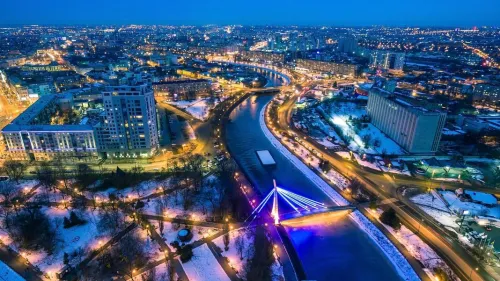
When you look at the shelling of Kharkiv, at the destroyed buildings of Karazin University, the Polytechnic, or warehouses with books and textbooks, the natural reaction is pain.
But in parallel, another wave is driving through social networks — a panic one: "Kharkiv is turning into a logistical dead end, a frontline zone without a future, everything must be evacuated from here..."
This is a typical aberration of vision, when people confuse passing tragic events with the fundamental code of the territory.
Kharkiv, like Wrocław, by its very nature belongs to a rare type of corporation-city.
Sloboda Ukraine was formed from the start as a free, contractual borderland. Kharkiv rose not thanks to the highest decrees from St. Petersburg, but on merchant fairs, the university, the railway, and the private capital of the Alchevsky family.
Wrocław (Breslau) was for centuries the richest craft and trade center, where the guilds of swordsmiths and armorers had huge funds. They ordered luxurious, lush cartouches with warrior-shieldbearers (the city guard) from local carvers to decorate their guild halls.
And this is another discovery of mine in the Wrocław Museum.
Since the days of the military fortress, crafts flourished in Kharkiv that, through the talent and skill of its residents, grew into large industrial and defense enterprises.
In 1805, Vasyl Karazin and local merchants collected their own money and founded Kharkiv University without a single kopeck from the imperial treasury. Even back then, they pragmatically calculated what the Wrocław patricians knew: material possessions can be confiscated or burned, but institutional intelligence cannot be taken away.
It was this private and merchant choice that made Kharkiv a scientific-technological hub — with its engineering schools, institute of physics and technology, and modern IT cluster.
And that is precisely why targeted strikes on Kharkiv universities and printing houses are no accident. It is an attempt to destroy the city's intellectual autonomy, because it is organically incompatible with the imperial matrix.
Set emotions aside — this is dry historical pragmatism at work:
A city survives through flexibility. Just as Wrocław for centuries sought and found loopholes in imperial laws, buying out its right to development, Kharkiv right now adapts to new conditions: moves manufacturing and schools underground, maintains complex logistics, and supplies the front.
Academic and social capital has no expiration date. Money can zero out, as happened to the Uthmanns' fortune during the Thirty Years' War. Buildings will require rebuilding. But the engineering school, entrepreneurial streak, network mutual assistance, and the ability to create added value do not disappear anywhere.
A city is made a "dead end" not by borders and not by missiles. A city is made a dead end by the lack of vision in its residents.
The Habsburg Empire is not on the map. The Prussian Empire is not on the map. The Russian and Soviet ones — are gone. But Wrocław stands, works, and remains the key center of Lower Silesia.
The remnants of the Russian empire will walk that same path of historical collapse. And Kharkiv will rebuild and reclaim its status as the main economic and scientific hub of Eastern Europe.
Because this is not a matter of faith or pathos — it is a working survival algorithm of corporation-cities, tested by the last four centuries.
More illustrations in the Ukrainian original.

Comments
Some more relevant news for now